The AI Agent Success Rate Nobody's Measured for People With No IT Team
KEY TAKEAWAYS
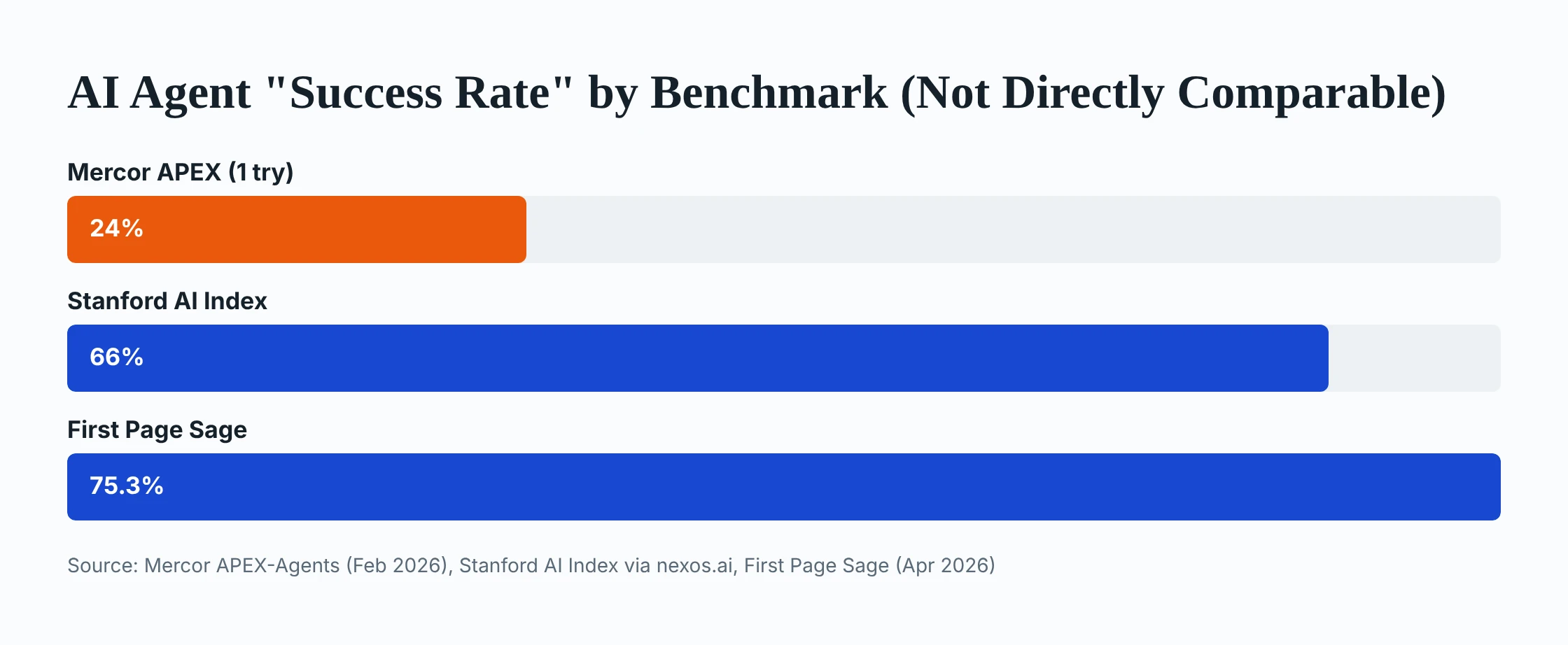
- → Three "AI agent success rate" numbers are circulating right now -- 66%, 24%, and 75.3% -- and they measure three different things, not one trend (Stanford AI Index via nexos.ai commentary; Mercor APEX-Agents benchmark; First Page Sage 2026 panel)
- → The toughest test, Mercor's 480-task benchmark against real financial analysts, consultants and lawyers, found top agents succeed on a single try only 24% of the time, and just 13.4% of the time if every one of 8 attempts has to succeed
- → Zero of the three benchmarks break results out by business size or operator technical skill level
- → The only source claiming a small-business-specific gap is a vendor (nexos.ai), and its supporting adoption stat is attributed to two different, unconfirmed origins across the outlets reporting it -- we're flagging it as unverified, not citing it as fact
- → None of the three benchmarks simulates the actual solo-operator scenario: a non-technical owner delegates a real task with no second reviewer and no IT team to catch a mistake before it costs money or a client
- → Read this as a data gap, not a data point: the number that would actually tell a solo operator how much to trust an agent with their business doesn't exist yet
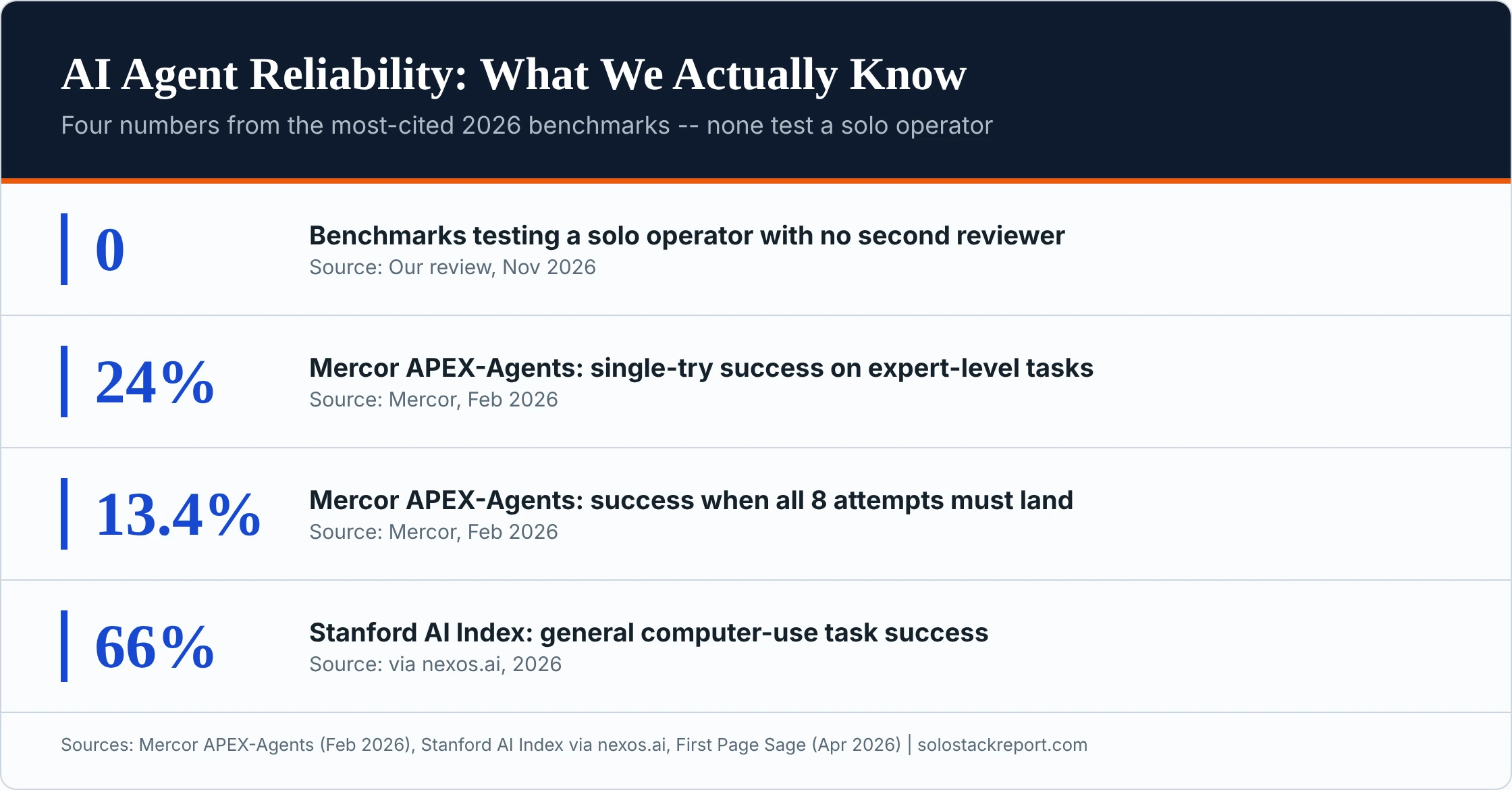
"AI agents now succeed X% of the time" is being quoted as if it were one settled number. It isn't. Three separate 2026 benchmarks, run by three different organizations on three different populations, each produced a headline success rate -- and nobody has stitched them together, let alone asked what any of them mean for the one person who owns the account, the budget, and the fallout if the agent gets it wrong.
1 Three Numbers, Three Different Tests
"AI agents now succeed X% of the time" is being quoted as if it's one settled number. It isn't. Three separate 2026 benchmarks produced three separate figures, testing three different things, on three different populations.
| BENCHMARK | HEADLINE RATE | WHAT IT ACTUALLY TESTS |
|---|---|---|
| Stanford AI Index (via nexos.ai) | 66% up from 12% a year earlier | General computer-use tasks: opening files, navigating apps, multi-step workflows. No stated sample or population. |
| Mercor APEX-Agents | 24% single attempt | 480 expert-level finance, consulting and legal tasks, benchmarked against 227 real professionals averaging 10.8 years' experience. |
| First Page Sage (2026 panel) | 75.3% mean, self-reported | 8,128-user rolling panel; the 75.3% figure comes from a 487-user sub-sample on complex multi-step tasks, self-reported. |
Mercor's own benchmark gets harder, not easier, the more realistic you make the bar: allowing 8 attempts per task raises the top model's "succeed at least once" rate to 36-40%, but requiring it to succeed on every one of those 8 runs drops the top model to 13.4% -- and open-source models fall below 5%. Open-source and lower-tier models are not broken out in the other two benchmarks at all, which hides a wide range behind each single headline percentage.
None of this means AI agents are secretly worse (or better) than the headline number you've seen. It means the three numbers getting quoted interchangeably right now answer three different questions, and none of them is the question a solo operator actually needs answered.
2 The One SMB Claim We Could Find -- And Why We're Not Citing It as Fact
Exactly one source frames this as a small-business-specific problem. It's a vendor, and its supporting number doesn't hold up to a second look.
Commentary from nexos.ai, the AI-agent vendor whose head of product is quoted framing the Stanford 66% figure, claims the "deployment gap is sharpest" at small and mid-sized businesses, because they lack dedicated IT and engineering teams. That's a plausible claim and matches the intuition behind this whole piece. But the statistic used to support it -- that 76% of small businesses now use AI in some form, while only 14% have integrated it into daily operations -- is attributed two different ways across the outlets covering the same press material: one calls it "industry survey data," another calls it "a 2026 Goldman Sachs survey." Neither names a publicly findable primary source.
| CLAIM | ATTRIBUTION AS REPORTED |
|---|---|
| 76% adoption / 14% daily-operations integration | "Industry survey data the company cites" (Compare the Cloud) |
| Same 76% / 14% figures | "A 2026 Goldman Sachs survey" (PFFC-Online) |
We're not saying the SMB deployment gap is false. We're saying the one number anyone has offered to quantify it doesn't currently trace to a source we can verify, so we're treating "small businesses lag on AI integration" as a plausible but unproven claim -- the same standard we'd want anyone citing our numbers to apply.
3 What a Real Solo-Operator Benchmark Would Have to Test
Stack the three existing benchmarks side by side and a specific missing test case becomes obvious.
Stanford's benchmark tests an agent operating a computer in general -- it says nothing about who assigned the task or who's checking the output. Mercor's tests elite professionals doing their own specialty work, then compares an AI agent attempting the identical task -- useful for capability tracking, but the "human in the loop" in that study is the expert being replaced, not a non-expert supervising. First Page Sage's panel is self-reported outcomes from a mixed consumer base, with no split by business ownership, technical background, or whether anyone double-checked the result.
None of them test the actual solo-operator condition: a non-technical owner hands an agent a real task -- send the invoice reminders, reconcile this month's books, draft the contract -- and there is no second reviewer, no IT ticket to file, and no engineering team to notice the agent quietly did something wrong. That is exactly the scenario this week's own news covers: Collective's AI now runs bookkeeping, payroll and tax filing for solo businesses (see our coverage of its $100M raise), and Anthropic's own "Claude Duet" -- an always-on agent explicitly pitched at "professionals and small business owners," announced October 21, 2026 -- approves payments and signs documents with a human glancing at a notification, not a team reviewing a log. Both are real products making real decisions for people in exactly the gap these benchmarks don't test.
4 Why This Matters for a Solo Stack
Nobody can currently tell you how reliable an agent is for someone in your specific position. The safest response is fewer, more closely-watched agents rather than more unverified point solutions.
If nobody can currently tell you how reliable an agent is for someone in your specific position -- no IT team, no second reviewer, real money and real clients on the line -- then the safest version of "let AI run more of my business" isn't adding more individually unverified point-solution agents. It's narrowing to fewer agents you can actually watch closely enough to build your own confidence in, one real result at a time. We've made a version of this argument before about the time cost of switching between tools; the reliability gap described here is the same logic applied to trust instead of time. A tool that replaces several single-purpose agents has a structural advantage here too: fewer unverified failure rates stacked on top of each other, and more of your own direct track record with the one system you actually use. If you want to test that logic against a specific general-purpose agent, Runable's free plan is a no-cost way to start building that track record yourself -- the gap described above doesn't go away either way, but watching one agent closely is more tractable than watching five.
Methodology
How we built this. In November 2026 we searched for published AI agent task-success or reliability benchmarks and reviewed the three most-cited 2026 figures: Stanford's AI Index computer-use result (as reported via nexos.ai commentary, since we could not independently access the primary Stanford dataset in this pass), Mercor's APEX-Agents benchmark (480 tasks across 33 project environments in investment banking, management consulting and corporate law, benchmarked against 227 human professionals, reported via BankInfoSecurity, Feb 2026), and First Page Sage's "Agentic AI Statistics: 2026" panel (8,128 users, a 487-user sub-sample for the complex-task completion figure, published Apr 2026). We then searched specifically for any benchmark breaking results out by business size, operator technical skill, or the presence/absence of a second reviewer, and found none. We checked the one small-business-specific claim we found (nexos.ai's 76%/14% adoption figure) against two outlets reporting it and found inconsistent sourcing. We did not run our own benchmark or user study.
- Sources consulted: 6 opened and checked; 4 cited
- Data range: February 2026 (Mercor) through April 2026 (First Page Sage), reviewed November 2026
- Last verified: November 7, 2026
- Update schedule: Revisited if a benchmark is published that specifically isolates solo or non-technical operators
Limitations: We did not independently access the primary Stanford AI Index report or the First Page Sage full report; figures for those two are taken from secondary coverage and should be re-verified against the primary documents before being treated as precise. The Mercor figures come from a benchmark built by a commercial AI recruiting firm and reported through a trade-publication blog, not a peer-reviewed source. "Success" is defined differently in each benchmark (computer-task completion vs. expert-task-equivalent output vs. self-reported satisfaction), so none of the three percentages should be subtracted, averaged, or directly compared to each other as presented in this article's table -- we show them together specifically to make that point, not to imply they're on the same scale.
Frequently Asked Questions
What is the success rate of AI agents?
It depends entirely on which benchmark you mean, and the three most-cited 2026 numbers are not comparable. Stanford's AI Index puts agent success on general computer-use tasks at 66%, up from 12% a year earlier. A Mercor-built benchmark of 480 expert-level finance, consulting and legal tasks found top agents succeeded on a single try only 24% of the time. First Page Sage's consumer usage panel reports a 75.3% mean self-reported completion rate on complex multi-step tasks. Each measures a different population doing different work.
Do any AI agent benchmarks break results out by business size?
No independent, methodologically transparent benchmark we found segments results by business size or operator technical skill level. The closest is a vendor (nexos.ai) asserting a deployment gap at small and mid-sized businesses, citing an adoption statistic that is attributed inconsistently across outlets and should be treated as unverified.
Is there data on how reliable AI agents are for solo business owners specifically?
We could not find any. Every benchmark we reviewed tests either general computer-use tasks, elite professionals' own specialty tasks, or a mixed consumer panel's self-reported outcomes -- none simulate a non-technical owner delegating a real business task with no second reviewer and no IT team to catch a silent failure.
Why hasn't anyone measured AI agent reliability for solo operators?
Likely because neither group currently doing the measuring has a reason to isolate that segment: vendors benchmark to sell to enterprise buyers, and academic benchmarks track raw model capability. Neither asks who is watching the agent work, which is the variable that matters most once there is no team behind the one person using it.
Is this article saying AI agents aren't reliable enough for solo businesses?
No. It's saying nobody has published the data to answer that question either way for this specific group. Collective's $100M raise and Anthropic's Claude Duet both show real products already making real financial and admin decisions for solo operators -- we just don't have an independent reliability number for that exact use case yet.
Sources
- Compare the Cloud. "AI agent task success jumps from 12% to 66% in a year, but deployment gap widens at SMBs, nexos.ai warns." comparethecloud.net. Published April 24, 2026. Accessed November 2026.
- PFFC-Online. "AI Agents Jumped From 12% to 66% Task Success in One Year." pffc-online.com. Accessed November 2026.
- BankInfoSecurity (Rahul Neel Mani). "24% Success Rate for AI Agents -- Is That Acceptable?" bankinfosecurity.com. Published February 3, 2026. Accessed November 2026.
- Digital Applied, citing First Page Sage "Agentic AI Statistics: 2026." digitalapplied.com. Published June 12, 2026. Accessed November 2026.
Published November 7, 2026. Last updated November 7, 2026.