Runable vs Zapier (2026): Which Should a Solo Operator Use?
Zapier runs the same steps every time something happens. Runable does a job you describe in plain language. If your work is repeatable and triggered by events, Zapier is the better fit. If it needs drafting, research or judgment, or you want to replace several light-use apps, Runable is the one to test. Many solo operators will end up using both.
This is a research-based comparison. We have not hands-on tested either product. Everything below comes from each vendor's own pages and public third-party coverage, all checked on October 10, 2026, and we say where a claim is the vendor's own. We earn a commission if you sign up for Runable through our link, which does not change what we write.
KEY TAKEAWAYS
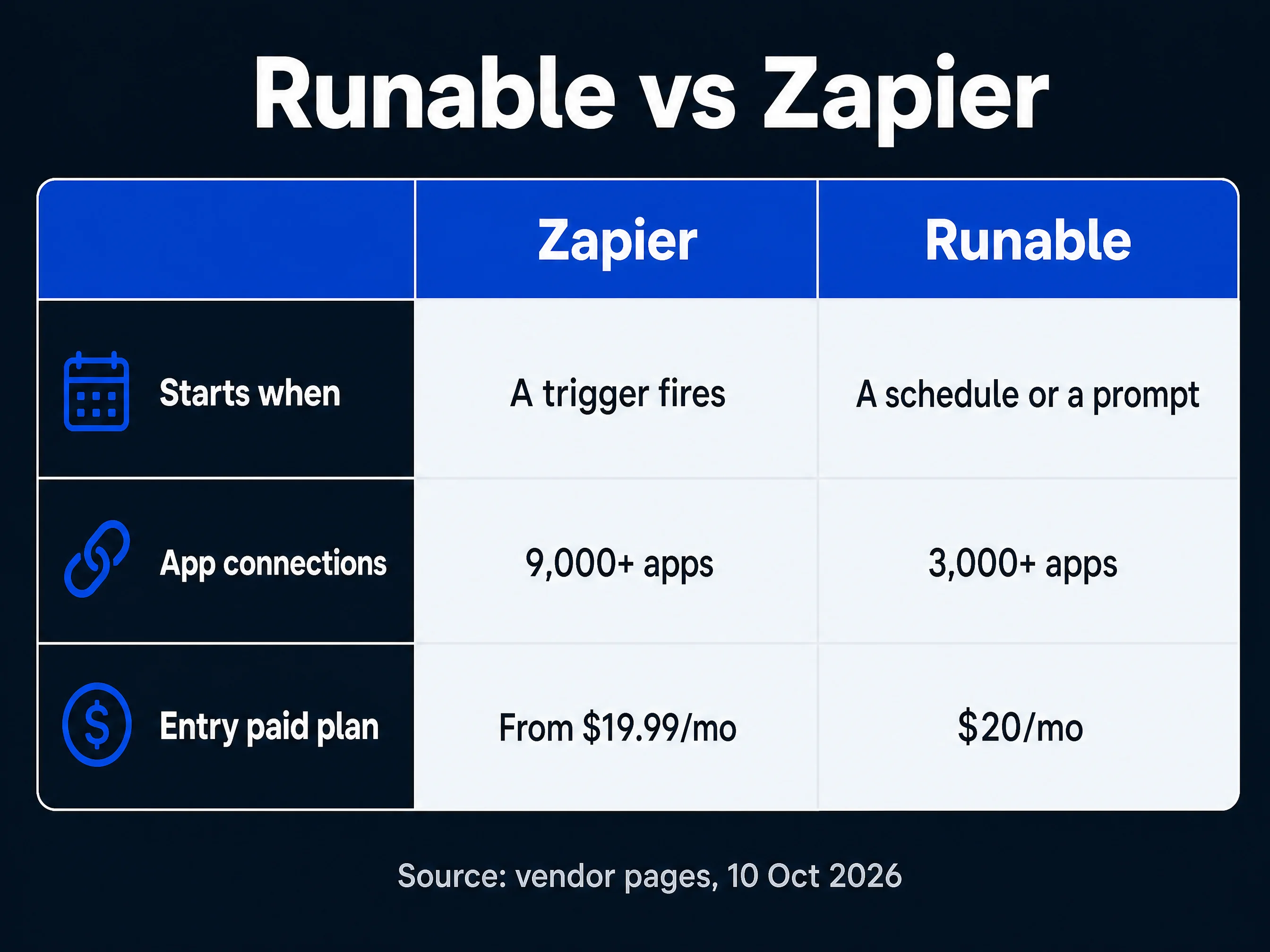
- → Zapier runs a workflow after a trigger fires, and cites 9,000+ apps (Zapier homepage, Oct 2026)
- → Runable's scheduled tasks run once, daily, weekly or monthly, and its page describes time-based schedules only (Runable, Oct 2026)
- → Runable connects to 3,000+ apps through plugins (Runable plugins page, Oct 2026)
- → Entry prices are close but not comparable: Zapier from $19.99/mo for 100 tasks, Runable Pro $20/mo for 25,000 monthly credits (vendor pricing pages)
- → No independent source we found measures reliability or real cost per job for either tool
1 Which Should You Use? A Decision Table
Pick by the shape of the work, not by the brand. Fixed steps triggered by something happening point to Zapier. A job you would otherwise brief a person on points to Runable.
| YOUR SITUATION | BETTER FIT | WHY |
|---|---|---|
| New payment should add a row and send a Slack alert | Zapier | Event trigger, fixed steps, same result every time |
| Weekly competitor check and a written summary | Runable | Scheduled task plus research and writing; Runable's page gives this kind of example |
| Draft a deck, a page or a report from a brief | Runable | Output creation, not data moving |
| Sync data between two apps all day | Zapier | Built for connecting apps by trigger |
| Paying for several light-use creative tools | Test Runable | See our stack cost comparison |
The table is our reading of the vendors' own descriptions, not a test result.
2 How Do Their Triggers and Integrations Differ?
Zapier is a trigger-and-action network with a much larger app count. Runable is an agent with schedules and a smaller plugin library. They overlap less than the word "automation" suggests.
| FEATURE | ZAPIER | RUNABLE |
|---|---|---|
| App connections (vendor claim) | 9,000+ apps, 66,000+ triggers and actions | 3,000+ apps via plugins |
| How work starts | A Zap runs on its own after a trigger is set | Scheduled tasks: once, daily, weekly or monthly; chat prompts |
| Event-based triggers | Yes, per its homepage | Not described on the pages we read |
| How you build | Steps you configure; AI agents and AI fields available | Describe the job in plain language |
| Where results go | Into your apps | Email, app, iMessage, Slack, Teams, Discord, Telegram |
| Source | Zapier homepage and pricing page | Runable plugins, scheduled-tasks and pricing pages |
Zapier's homepage also says each Zap has an AI manager that watches for problems, and that its agents handle multi-step work before handing off to fixed steps. The page quotes more than 3 million businesses using it, which is Zapier's own figure. On Runable's side, the plugins page names Slack, Gmail, Google Drive, Notion and Shopify and says you authorize them in one click, but it does not state limits or which plans include plugins. Runable's workflows page is a catalogue of ready-made flows and does not document how to build your own or what triggers them. "Not described" is not the same as "not possible," so ask Runable before relying on event triggers.
3 How Does the Pricing Compare?
The headline prices look alike, about $20 a month, but they buy different things: Zapier sells tasks, Runable sells credits. You cannot convert one into the other from the public pages.
| PLAN | PRICE | WHAT THE PAGE STATES |
|---|---|---|
| Zapier Free | $0 | 100 tasks/month, two-step Zaps only, 15-minute polling |
| Zapier Professional | from $19.99/mo | Multi-step Zaps, premium apps, webhooks, 2-minute polling; tiers from 100 to 2M tasks |
| Zapier Team | from $69/mo | 25 users, shared Zaps, SSO |
| Zapier Agents Pro | $400/yr ($33.33/mo) | 1,500 activities/month |
| Runable Free | $0 | 1,500 credits a day, no rollover |
| Runable Pro | $20/mo | 25,000 monthly credits plus the daily 1,500 |
| Runable Max | $100/mo | 150,000 monthly credits plus the daily 1,500 |
One comparison site, Toolradar, lists Runable as "100% free" with no paid tiers, which does not match Runable's own pricing page. A TLDL article from February 2026 gives example monthly costs for each approach but states no method or sources for them, so we have not repeated its figures. If you want to put your own numbers against Runable's plans, our Stack Cost Calculator does the sum, and the credit system is explained in our Runable review.
4 Which One Is More Reliable?
The evidence is thin for both. The one article we found that argues the point says fixed-rule automation is more dependable than AI agents, but it provides no measurements.
TLDL's February 2026 article frames Zapier-style automation as "if this, then that" and AI agents as goal-driven, and concludes that using both is usually right. It prefers a workflow that always succeeds over one that succeeds most of the time, and it recommends a hybrid for solo founders. TLDL sells its own products and does not credit an individual author, so treat that as one opinion.
User ratings are tiny samples. Toolradar shows Zapier at about 4.0 to 4.1 out of 5 across roughly 2,146 reviews on G2 and PeerSpot, and Runable at 5.0 from five Trustpilot reviews. Our own check of Runable's Trustpilot page found 3.3 out of 5 from four reviews, split between five stars and one star, which is why we do not draw conclusions from either number. The Toolradar page is partly templated and contradicts itself, so verify anything you take from it.
5 Should You Use Both?
For most solo operators, probably yes. Let Zapier handle the rule-based plumbing and an agent handle the work that needs writing, research or judgment. That keeps the cheap, predictable part cheap.
If you already pay for several single-purpose apps, the more useful question is which ones an agent could drop, not whether to abandon automation. Our price comparison of a five-tool stack shows where the money goes, and the Tool Sprawl Tax covers the time cost of switching between apps. If agents with their own accounts and wallets appeal, read our take on Manus's Cue launch first, because giving an agent access to payments raises questions neither Zapier nor Runable's pages answer. To test Runable without paying, start on its free plan. That is an affiliate link.
Methodology
Research-based, not hands-on tested. On October 10, 2026 we read Zapier's homepage and pricing page, Runable's homepage, pricing, plugins, workflows, scheduled-tasks and compare pages, a Toolradar comparison page (updated September 17, 2026), and a TLDL article from February 18, 2026. We built nothing on either platform. Vendor counts and customer stats are the vendors' own claims. We found no independent test of either product's reliability or cost per job. Prices change often, so check each vendor before buying. We will update this page when the facts change.
Frequently Asked Questions
Can Runable replace Zapier?
Only partly. Runable's scheduled tasks run at times you choose (once, daily, weekly or monthly), and its page describes no event-based triggers. Zapier runs a Zap on its own after a trigger fires. If your work depends on events such as a new payment or form entry, Zapier fits better.
Which is cheaper, Runable or Zapier?
The prices are not comparable. Zapier's Professional plan starts at $19.99 a month for 100 tasks. Runable Pro is $20 a month for 25,000 monthly credits plus 1,500 daily credits. Neither page shows what a typical job costs in the other's units, so test your own workload.
How many apps does each connect to?
Zapier's homepage cites 9,000-plus apps and 66,000-plus triggers and actions. Runable's plugins page cites 3,000-plus apps, with Slack, Gmail, Google Drive, Notion and Shopify named. Both counts are the vendors' own claims, and they measure different things, so check that your specific apps are supported.
Is an AI agent less reliable than a Zap?
One comparison article, from TLDL in February 2026, argues fixed-rule automation is more dependable than AI agents, while giving no reliability metrics. We found no independent measurement for either product, so test your own workflow before trusting it with anything important, such as payments or customer data.
Can I use both?
Yes, and it is a common recommendation. Use Zapier for repeatable, event-driven steps such as payments and notifications, and an agent for work that needs judgment, drafting or research. TLDL's February 2026 article recommends this hybrid for solo founders, and nothing on either vendor's page prevents it.
Is Runable free?
Runable has a free plan with 1,500 credits a day that reset daily. It also sells Pro at $20 a month and Max at $100 a month, per its pricing page on October 10, 2026. At least one comparison site calls Runable 100% free, which does not match that page, so use the vendor's page.
Sources
- Zapier. Homepage and pricing page. zapier.com, zapier.com/pricing. Accessed October 10, 2026.
- Runable. Pricing, plugins, scheduled tasks, workflows and compare pages. runable.com/pricing, /ai-plugins, /scheduled-tasks, /workflows. Accessed October 10, 2026.
- Toolradar. "Runable vs Zapier: Which is Better in 2026?" (updated September 17, 2026). toolradar.com. Accessed October 10, 2026.
- TLDL. "AI Agents vs Zapier" (February 18, 2026). tldl.io. Accessed October 10, 2026.
Last updated: October 10, 2026.