The Tool Sprawl Tax: How Much Time Solo Businesses and Creators Lose Switching Between Apps (2026)
KEY TAKEAWAYS
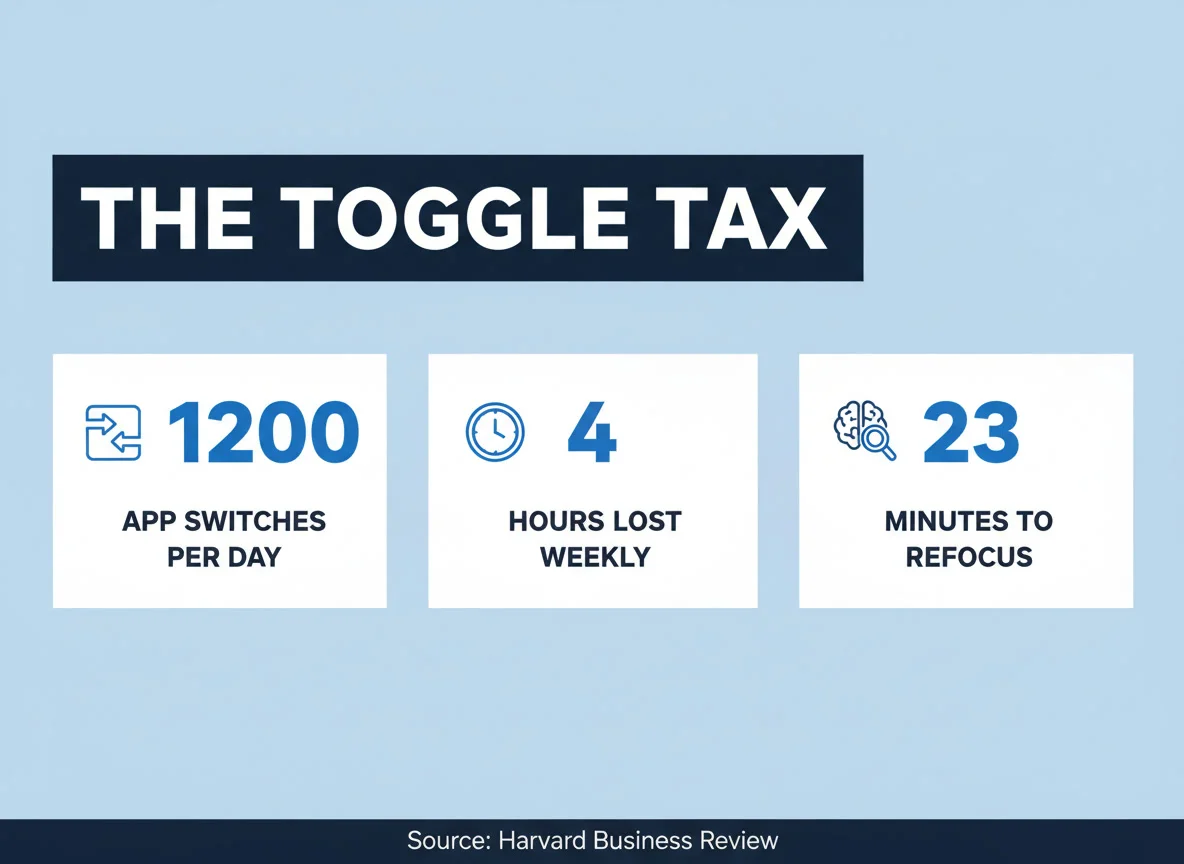
- → Workers switch apps roughly 1,200 times a day, losing close to 4 hours a week — about 5 working weeks a year — just reorienting themselves (Harvard Business Review, 2022)
- → A single interruption takes an average of 23:15 to fully recover from (Gloria Mark, UC Irvine)
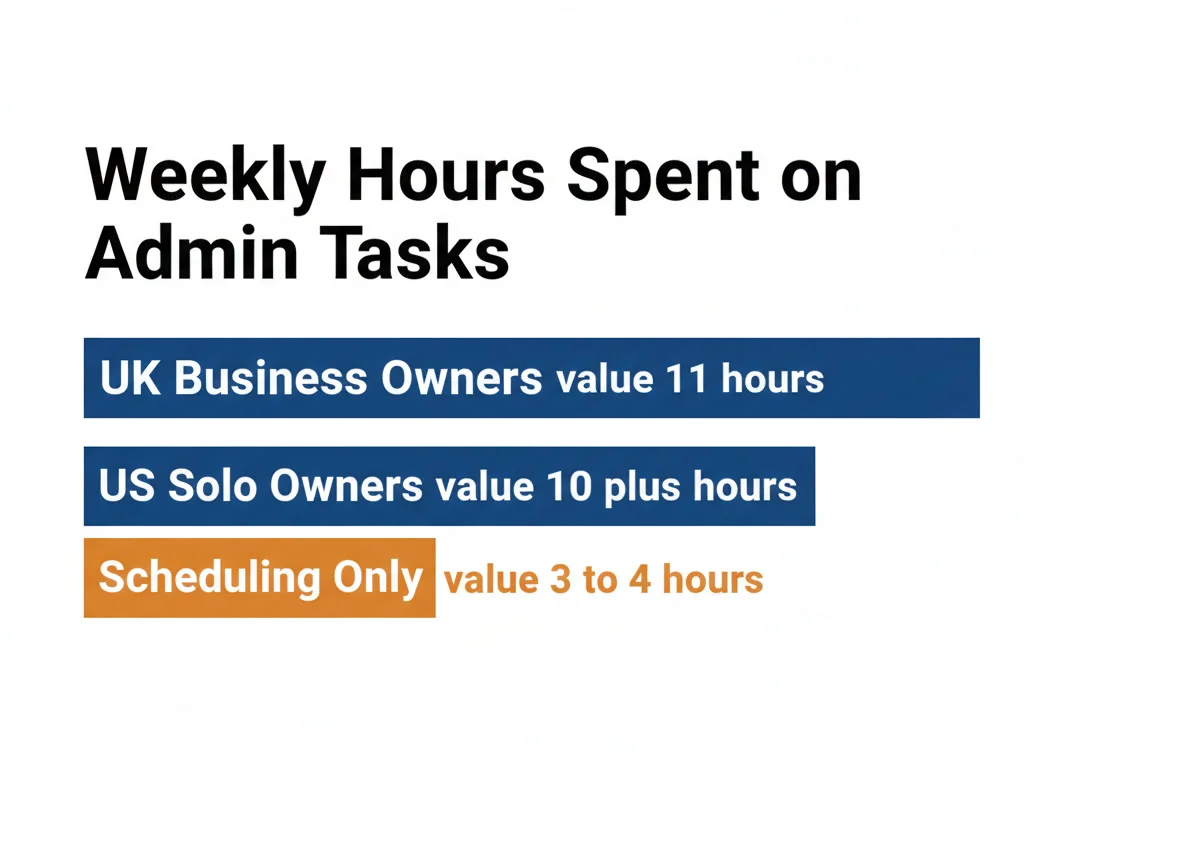
- → UK small business owners spend an average of 11 hours/week on admin and finance tasks — about 6 working days a month (Amex SME Business Barometer, Jul 2026)
- → 57% of US solopreneurs and microbusiness owners spend more than 10 hours a week on admin (FreshBooks/Wakefield Research, Sept 2026)
- → 1 in 4 workers spend 3–4 hours a week just scheduling meetings (Calendly State of Scheduling, 2023)
- → Independent podcasters report typical stacks spanning 6–10+ separate tools across recording, editing, hosting, and promotion (r/podcasting, Nov 2025)
- → Yoga and wellness studio booking software ranges from $49 to $557/month depending on platform and tier (OfferingTree, 2026)
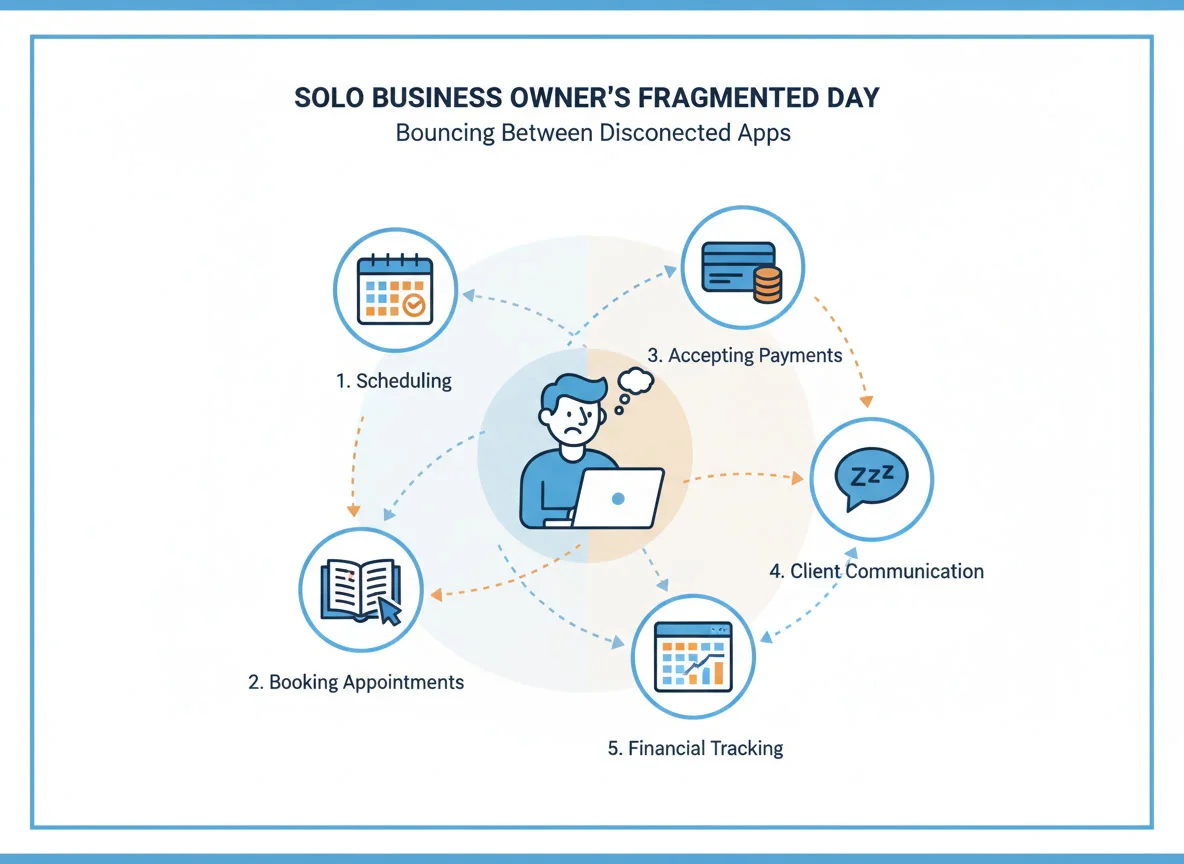
A solo yoga instructor replies to a booking message on her phone, opens a separate app to check the master calendar, switches to a third to confirm payment, then jumps to a spreadsheet because the first two don't talk to each other. A podcaster finishes recording and immediately loses the next two hours to show notes, thumbnail art, and social clips — spread across five different tools. This is tool sprawl in practice, and it's the day-to-day reality reported by independent operators across Reddit's small-business and creator communities — one that lines up with what general workplace research says app-switching actually costs. This article pulls both together: the broad research on context-switching cost, and what tool sprawl looks like specifically for solo service businesses and independent creators.
1 How Much Does App-Switching Actually Cost?
Knowledge workers toggle between apps and websites about 1,200 times a day, losing nearly 4 hours a week — roughly 9% of work time — reorienting themselves after each switch. A single interruption takes over 23 minutes to fully recover from.
| METRIC | VALUE | SOURCE |
|---|---|---|
| App/website switches per day | ~1,200 | Harvard Business Review, 2022 |
| Time lost reorienting per week | ~4 hours (9%) | Harvard Business Review, 2022 |
| Switches for a supply-chain team task | ~350 across 22 apps | Harvard Business Review, 2022 |
| Time to fully recover after one interruption | 23 min 15 sec | Gloria Mark, UC Irvine (CHI 2008) |
| Other tasks squeezed in before returning | 2.26 average | Gloria Mark, UC Irvine |
This research covers knowledge workers broadly — not solo business owners specifically — but it's the foundational data point for everything that follows: the base rate of what fragmentation costs before a single tool gets added on top. The underlying interruption-recovery research from UC Irvine, first popularized in 2006 and still the most-cited figure in 2026 productivity coverage, adds a second layer: it's not just the number of switches, it's how long each one actually derails focus.
2 How Many Hours a Week Do Solo Operators Spend on Admin?
UK small business owners average 11 hours a week on admin and finance tasks — about six working days a month. In the US, 57% of solopreneurs and microbusiness owners report spending more than 10 hours a week on the same kind of work.
The scheduling-specific figure comes from Calendly's 2023 State of Scheduling report and covers the general worker population rather than founders specifically — the most recent disclosed data on that particular slice, even though it predates the 2026 admin-time surveys above. Separately, FreshBooks' 2026 survey of 500 US solopreneurs found a related pattern: 86% now try AI before hiring for a task they can't do themselves, and 90% say AI makes it easier for one person to run a business — suggesting operators are already reaching for automation to claw back exactly these hours.
3 How Many Tools Does a Typical Solo Business Actually Run On?
No formal survey has measured this for the solo/micro-business segment specifically — but real-world stacks that independent operators report running commonly span 4 to 10+ separate, disconnected tools, often just to handle scheduling and payments alone.
| REPORTED CASE | TOOL COUNT | SOURCE |
|---|---|---|
| Small business owner, 3 companies | ~18 services, ~£4,000/mo | r/smallbusiness, user-reported |
| 6-person wellness business (booking alone) | 4 disconnected tools | r/smallbusiness, user-reported |
| Independent podcast production stack | 6–10+ tools | r/podcasting, 25+ respondents |
These are self-reported figures from independent operators, not a population-level statistic — and they're presented that way deliberately, rather than dressed up as a formal average. One r/smallbusiness thread captures the pattern precisely: a wellness business owner described juggling Calendly for online bookings, Google Calendar for the master schedule, a separate staff shift-tracking app, and a shared spreadsheet as a manual "tie-breaker" — and still ran into double-bookings. In a separate thread, 25+ independent podcasters listed their production stacks; typical setups spanned recording, editing, hosting, transcripts, thumbnail art, and social scheduling as six or more distinct subscriptions. One respondent, after what they called a "tool bloat spiral," summed up the fix: "I used to juggle a separate recorder, a DAW, and a clipping tool… paying for three things that one platform does." That consolidation instinct is exactly where products like Runable — an AI agent built to plan, build, and run a small business or content operation from a single interface — are positioned to compete with the pieced-together stack, rather than adding one more tool to it.
4 What Does This Look Like for Yoga and Wellness Studios?
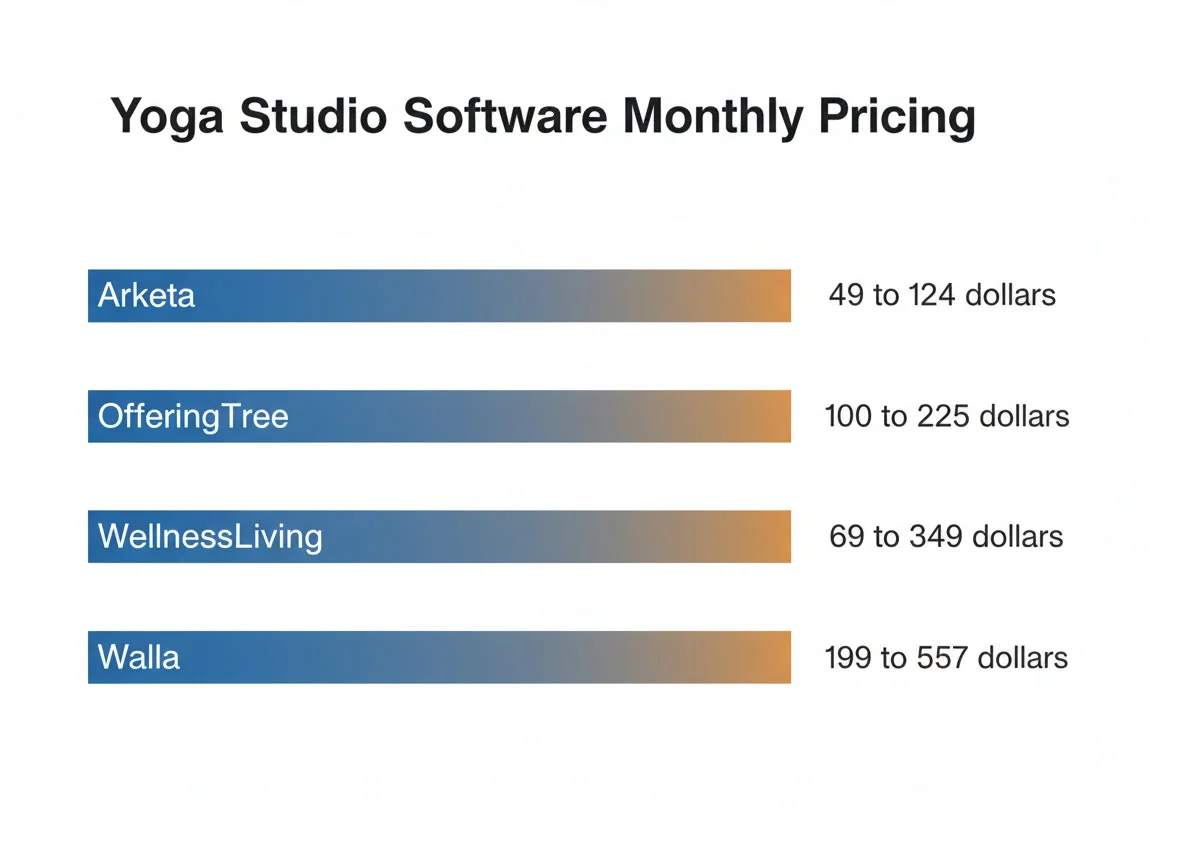
Yoga and wellness studio booking software ranges from about $49 to $557 a month depending on platform and tier, and several platforms add per-transaction processing fees on top — Mindbody discloses 2.75% + $0.25 per transaction, which can add hundreds of dollars a month at real studio volumes.
| PLATFORM | MONTHLY RANGE | SOURCE |
|---|---|---|
| Arketa (individual tiers) | $49–$124 | OfferingTree buyer's guide, 2026 |
| OfferingTree | $100–$225 | OfferingTree buyer's guide, 2026 |
| WellnessLiving | $69–$349 | OfferingTree buyer's guide, 2026 |
| Walla | $199–$557 | OfferingTree buyer's guide, 2026 |
On r/YogaTeachers, the same pattern shows up as lived experience rather than a price sheet: instructors running small studios describe evaluating OfferingTree, Momence, and Vibefam specifically because per-transaction fees and add-on costs made their existing platform more expensive than advertised. A recurring thread is what one teacher called "the invisible second job" — replying to booking messages, sending reminders, and chasing late payments, conducted on a personal phone after class hours. The top-voted advice in that thread was blunt: "Any booking tool worth paying for sends the class reminder itself… [payment chasing] neither needs to be you." That's the exact gap that a consolidated, automation-first tool is built to close — reminders, rescheduling, and payment chasing handled without a human relaying messages between five apps.
5 What About Podcasters and Independent Creators?
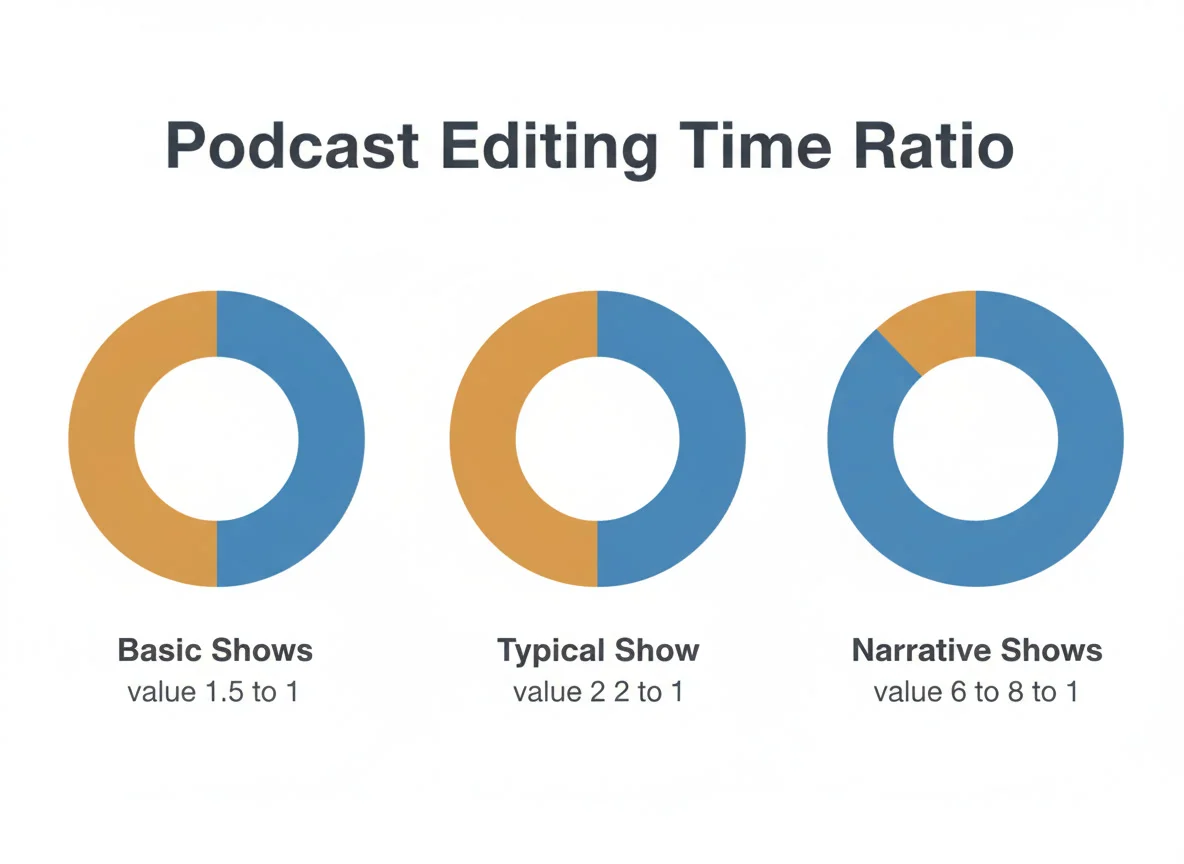
Community-reported data from 50+ podcasters suggests a typical editing ratio of about 2 hours of editing per 1 hour of finished content, ranging from 1.5:1 for simple conversational shows up to 6–8:1 for heavily produced narrative formats — and that's before accounting for show notes, thumbnails, and social promotion.
This figure comes from an informal but transparent community survey — a Reddit user aggregated 50+ self-reported responses rather than running a peer-reviewed study — so it's presented here as commonly-claimed, directionally reliable data rather than a hard population statistic. What's better documented is the shape of the problem beyond editing itself: in a separate r/podcasting thread, a solo host described the post-production admin — "writing the show notes, coming up with a title and description, cutting little clips for social" — as sometimes taking longer than the episode itself. That matches the broader pattern from Section 3: independent creators aren't just fighting editing time, they're fighting the handoff between five or six separate tools, each holding one piece of a single workflow.
6 What Replaces the Fragmented Stack
The pattern across every section above is the same: it is rarely one tool that is expensive, it is the seams between four, six, or ten of them — the manual re-entry, the double-booking, the spreadsheet standing in as a tie-breaker. Consolidating onto a single AI-driven workspace is the most direct fix reported by operators who have already made the switch.
Runable is one such consolidation play: an AI agent that plans, builds, and runs day-to-day operations — content (sites, slides, video, social), automation (scheduled tasks, follow-ups, a personal assistant reachable in Slack, Microsoft Teams, Telegram, iMessage, and Discord), and basic business infrastructure (app builder, database, Stripe integration) — from one interface instead of five or six separate subscriptions. Runable reports user-side results of up to 35% more bookings, a 50% cut in support requests, and 4x faster content turnaround — vendor-reported figures, not independently audited, and presented here as such rather than as verified statistics.
| PLAN | PRICE | WHAT'S INCLUDED |
|---|---|---|
| Free | $0/mo | 1,500 daily credits, site/app building, notetaker, 3,000+ plugins |
| Pro | $20/mo ($180/yr) | 25,000 monthly credits, 100+ workflows, cross-platform assistant, Stripe/DB/subdomain included |
| Max | $100/mo | 150,000 monthly credits, unlimited Ask-mode chats, all Pro features |
Pricing as published on runable.com/pricing, September 2026 — confirm current terms before publishing, as SaaS pricing changes without notice.
Estimate Your Own Tool-Switching Tax
Methodology
Research for this article combined three channels: Reddit threads from r/smallbusiness, r/YogaTeachers, and r/podcasting (searched and fetched September 2026) for real operator-reported experiences; Google Search for primary and industry sources on context-switching research, admin-time surveys, and vertical-specific pricing; and direct verification of every claim before inclusion. Three plausible-sounding statistics were checked and excluded after failing to trace to a real source — including one AI-search-summary claim that could not be traced to any actual study.
- Sources consulted: 21, across Reddit, Harvard Business Review, academic research (UC Irvine), industry surveys (American Express, FreshBooks/Wakefield, Calendly), and vendor comparison pages
- Sources cited: 11
- Data range: 2008 (foundational interruption-recovery study, still actively cited) through September 2026
- Last verified: September 20, 2026
- Update schedule: Reviewed quarterly; admin-time and pricing figures re-checked against source pages for changes
- Limitations: No population-level study measures tool count specifically for solo/micro businesses; those figures are presented as user-reported case studies, not statistics. The podcast editing ratio is a community survey, not peer-reviewed.
Frequently Asked Questions
How much time does app-switching actually cost a small business or creator?
Research on knowledge workers generally found roughly 1,200 app/website switches per day, costing close to 4 hours a week (about 9% of work time) in reorientation time — and a single interruption can take over 23 minutes to fully recover from. See the calculator above for a rough personal estimate.
How many hours a week do small business owners spend on admin instead of their actual work?
UK SME owners report averaging 11 hours/week on admin and finance tasks — about 6 working days a month. In the US, 57% of solopreneurs and microbusiness owners report spending more than 10 hours/week on admin tasks.
How many tools does a typical solo podcaster or small service business actually use?
No single authoritative count exists yet for this specific segment, but real-world stacks reported by independent operators commonly span 4–10+ separate tools — for podcasters, that's recording, editing, hosting, show notes, thumbnails, and social scheduling; for a solo wellness business, that's often 3–4 tools just for booking and scheduling alone.
How much does yoga or wellness studio booking software cost?
Major platforms range from about $49/month (entry tier) to $557/month (higher tiers), and several charge per-transaction processing fees on top — Mindbody discloses 2.75% + $0.25 per transaction, which can add hundreds of dollars a month at real studio volumes.
How long does podcast editing actually take?
Community-reported data from 50+ podcasters suggests a typical ratio of about 2 hours of editing per 1 hour of finished content for conversational shows, ranging from 1.5:1 for simple formats up to 6–8:1 for heavily produced narrative shows.
Sources & References
- Harvard Business Review. "How Much Time and Energy Do We Waste Toggling Between Applications?" hbr.org. Accessed September 2026.
- Gloria Mark, UC Irvine. "The Cost of Interrupted Work: More Speed and Stress." CHI 2008. ics.uci.edu. Accessed September 2026.
- American Express / Small Business Saturday UK. "SME Business Barometer." July 2026. channelx.world. Accessed September 2026.
- FreshBooks / Wakefield Research. "The Era of the Solopreneur." September 2026. globenewswire.com. Accessed September 2026.
- Calendly. "State of Scheduling 2023." calendly.com. Accessed September 2026.
- OfferingTree. "Yoga Studio Software Buyer's Guide." 2026. offeringtree.com. Accessed September 2026.
- r/podcasting community survey. "I analyzed 50+ responses: here's exactly how long podcast editing REALLY takes." July 2025. reddit.com. Accessed September 2026.
- r/smallbusiness. User-reported threads on tool count and cost. 2024–2025. reddit.com. Accessed September 2026.
- r/podcasting. "Your podcasting workflow in 2025, what tools do you use?" November 2025. reddit.com. Accessed September 2026.
- r/YogaTeachers. Threads on booking software and admin burden. 2026. reddit.com. Accessed September 2026.