SaaS Price Increases (2026): Software Is Inflating at 14.3% a Year
Key Takeaways
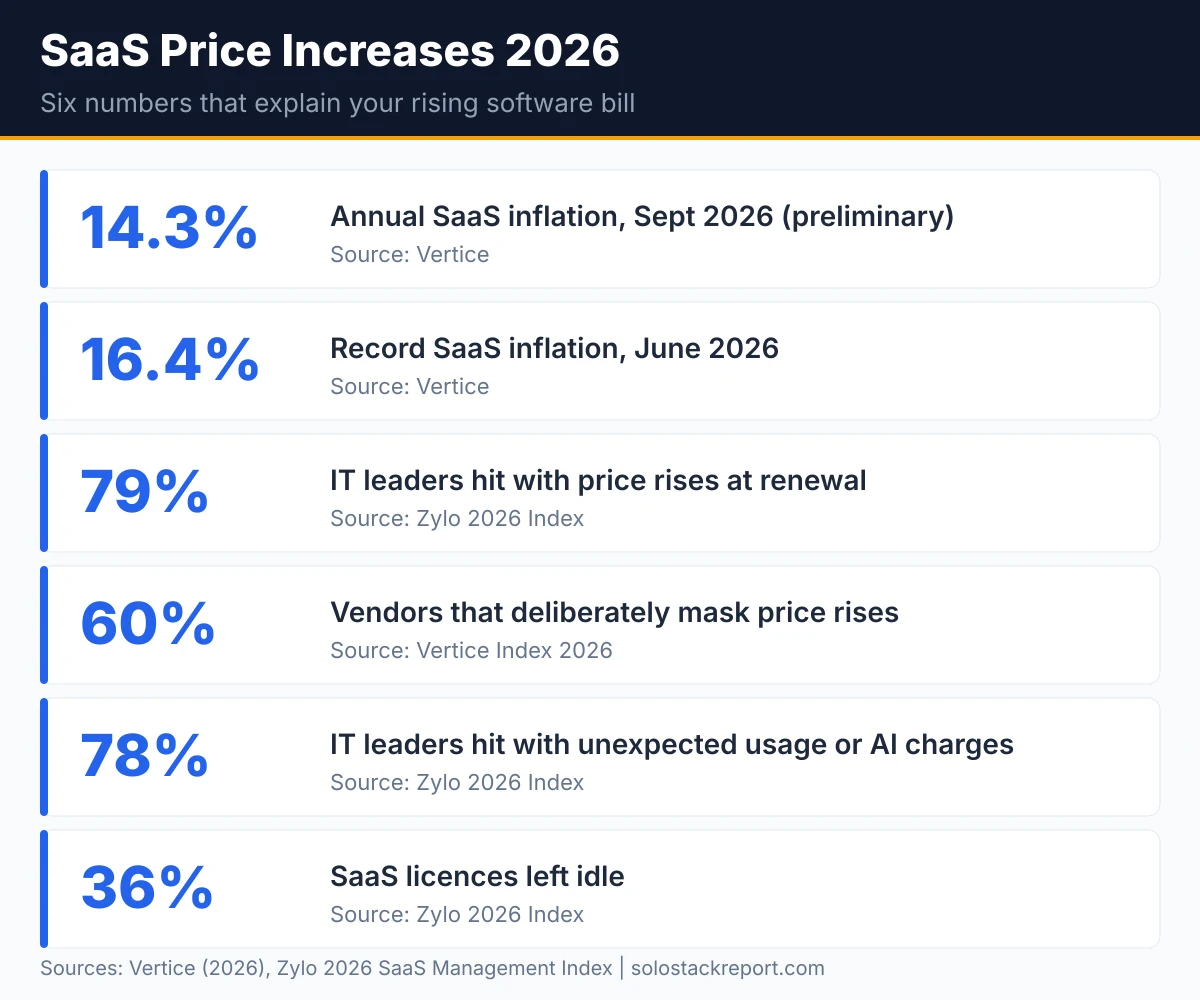
- → SaaS inflation ran at 14.3% in September 2026, after a record 16.4% in June. (Vertice)
- → That is nearly 5x standard G7 market inflation. (Vertice SaaS Inflation Index 2026)
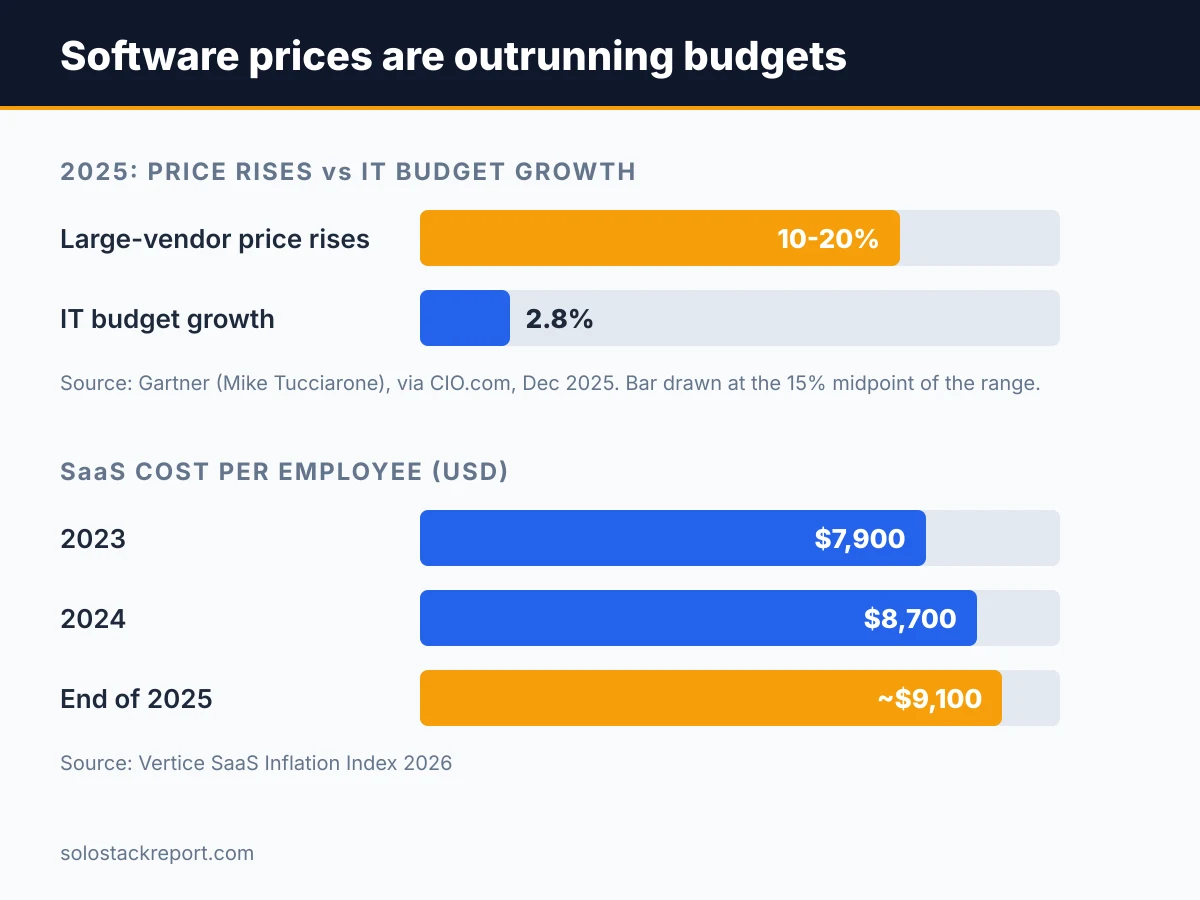
- → Several large vendors raised prices 10–20% while IT budgets were projected to grow just 2.8%. (Gartner, via CIO.com, 2025)
- → 79% of IT leaders saw price rises at renewal in the past 12 months. (Zylo 2026 SaaS Management Index)
- → 60% of vendors deliberately mask their price increases. (Vertice SaaS Inflation Index 2026)
- → 78% of IT leaders were hit with unexpected usage or AI charges after signing. (Zylo 2026 SaaS Management Index)
- → 36% of SaaS licences sit idle against recommended utilisation. (Zylo 2026 SaaS Management Index)
SaaS price increases are now running at double digits. Software subscriptions were getting dearer at an annual rate of 14.3% in September 2026, and hit a record 16.4% in June. General inflation in most economies has settled down. Software prices have not.
Most of the hard data comes from mid-size and enterprise buyers, because that is who the big spend-tracking firms serve. Nobody has published a large dataset for solo operators. But the forces behind the numbers, from tier reshuffles to surprise AI charges, hit every account regardless of size. This page pulls the freshest sourced figures into one place and shows what they mean for a one-person stack.
1How fast are SaaS prices rising in 2026?
SaaS prices rose at an annual rate of 14.3% in September 2026, according to preliminary Vertice data. The rate peaked at a record 16.4% in June and dipped to 12.7% in August.
| Metric | Value | Source |
|---|---|---|
| SaaS inflation rate, June 2026 (record) | 16.4% | Vertice |
| SaaS inflation rate, August 2026 | 12.7% | Vertice |
| SaaS inflation rate, September 2026 (preliminary) | 14.3% | Vertice |
| SaaS inflation vs standard G7 inflation | Nearly 5x | Vertice SaaS Inflation Index 2026 |
Vertice builds these figures from more than $75bn of spend it processed in 2026, so this is real invoice data rather than a survey of opinions. The September number is preliminary and may move. Even at its August low, though, software inflation was running well into double figures.
The comparison that matters is with everything else you buy. Vertice's 2026 index puts SaaS inflation at nearly five times the standard G7 market rate. If your rent, fuel and food bills rose at that pace you would notice immediately. Software slips through because it arrives as a dozen small direct debits instead of one big bill, which is exactly why pricing a typical five-tool solo stack from vendor pages is a useful baseline to check your own against.
2Vendors are raising prices 10–20% while budgets grow 2.8%
Several large vendors raised subscription prices by 10% to 20% in 2025, against projected IT budget growth of 2.8%, according to Gartner analyst Mike Tucciarone. The most extreme rises reached 900%, mainly from private equity-owned vendors.
| Metric | Value | Source |
|---|---|---|
| Price rises from several large vendors, 2025 | 10–20% | Gartner, via CIO.com |
| Projected IT budget growth, 2025 | 2.8% | Gartner, via CIO.com |
| Largest price rises seen, mainly PE-owned vendors | Up to 900% | Gartner, via CIO.com |
| Growth in private equity software deals, 2024 | 28% | Gartner, via CIO.com |
| Salesforce list price rise, Enterprise and Unlimited (Aug 2025) | 6% | Salesforce, reported by Zylo |
| Forecast global software spend growth, 2026 | 15.2% | Gartner, reported by SaaStr |
Gartner's forecast for 2026 makes the point bluntly. As reported by SaaStr, global software spend is expected to grow 15.2% this year, and about 9 percentage points of that comes from price rises on software companies already own. In plain terms: most of the extra money is buying the same software, not new capability.
Vendors justify the rises with the cost of building AI features and a shift towards usage-based pricing. Salesforce is a useful marker. It raised list prices on its Enterprise and Unlimited editions by 6% in August 2025, after 9% in 2023. Those are household-name tools with plenty of competitors, and they still raise prices on a schedule. That is part of why some founders are looking at big platforms pitching one assistant as the cure for app sprawl.
3Why most SaaS price increases go unnoticed
Because 60% of vendors deliberately mask them. Vertice found vendors combine headline rises with reduced features at the same tier, while Zylo found 78% of IT leaders were hit with unexpected usage or AI charges after signing.
| Metric | Value | Source |
|---|---|---|
| Vendors that deliberately mask price increases | 60% | Vertice SaaS Inflation Index 2026 |
| IT leaders who saw price rises at renewal (past 12 months) | 79% | Zylo 2026 SaaS Management Index |
| IT leaders hit with unexpected usage or AI charges | 78% | Zylo 2026 SaaS Management Index |
| IT leaders who cut projects due to unplanned SaaS increases | 61% | Zylo survey, 2026 |
| Price rises paired with fewer features at the same tier | Observed | Vertice (no rate published) |
The tier shuffle is the quiet one. Your plan keeps its name and price, but a feature you relied on moves up a level. Vertice notes this happens alongside list-price rises, though it does not publish how often. The effect on your bill is the same as a price rise; it just never shows up as one.
Usage and AI charges are the louder problem. If 78% of professional IT buyers, with procurement teams and contract reviews, still get caught out, a solo founder signing up on a card is in a weaker position. The renewal number matters too: when four in five buyers see a rise at renewal, assume yours is coming. It also explains why solo founders cycle through AI tools so quickly, since a surprise charge is often the moment someone cancels.
4SaaS now costs about $9,100 per person a year
SaaS cost per employee reached about $9,100 by the end of 2025, up from $8,700 in 2024 and $7,900 in 2023, according to Vertice. That is a rise of almost 15% in two years.
| Metric | Value | Source |
|---|---|---|
| SaaS cost per employee, 2023 | $7,900 | Vertice SaaS Inflation Index 2026 |
| SaaS cost per employee, 2024 | $8,700 | Vertice SaaS Inflation Index 2026 |
| SaaS cost per employee, end of 2025 | ~$9,100 | Vertice SaaS Inflation Index 2026 |
| Share of organisational spend going to SaaS | ~$1 in $8 | Vertice SaaS Inflation Index 2026 |
| Growth in SaaS spend, 2025 | Nearly 8% | Zylo 2026 SaaS Management Index |
These per-head figures come from organisations with staff, finance teams and enterprise contracts, so do not read $9,100 as what a solo founder should expect to spend. The useful part is the direction and the pace. A per-person cost that climbs almost 15% in two years compounds quickly, and a one-person business has no headcount to spread it across.
Time is the other cost these numbers miss. Every extra tool brings another login, another set of notifications and another place for work to get stuck, which is the hidden tax of switching between apps all day. A rising price on a tool you barely use is a double loss.
536% of SaaS licences sit idle
Organisations leave 36% of their SaaS licences idle against recommended utilisation levels, according to Zylo's 2026 SaaS Management Index. Meanwhile spend on AI-native apps rose 108% year on year.
| Metric | Value | Source |
|---|---|---|
| SaaS licences left idle | 36% | Zylo 2026 SaaS Management Index |
| AI-native app spend growth, year on year | 108% | Zylo 2026 SaaS Management Index |
| Expense-based SaaS spend growth, year on year | 267% | Zylo 2026 SaaS Management Index |
| Most expensed app | ChatGPT | Zylo 2026 SaaS Management Index |
Waste and price rises feed each other. An idle licence on a tool rising at double digits costs more every year it sits there. The expense-card pattern is the solo founder's default: sign up for a trial, forget it, keep paying. AI tools are the newest layer, and spend on them is growing fastest of all.
Some new products are explicitly positioning against this, from an AI bookkeeper built so it is not one more app to manage to agents that pay for tools on your behalf. Whether they reduce the bill or simply move it is still an open question.
6What SaaS price increases mean for a solo business
Assume every tool you pay for will cost more next year, and that some rises will be hidden in tiers or usage charges. The defence is a yearly audit: list every subscription, check what changed, and cut what you do not open.
In a widely discussed 2026 thread on r/Entrepreneur, the owner of a 12-person company said an annual audit found 23 software subscriptions costing $4,100 a month, against roughly $1,200 five years earlier for similar functionality. It is a single account that we cannot verify, but the pattern they describe, steady annual rises plus features moving up a tier, matches what the Vertice and Zylo data shows.
The most upvoted replies in that thread did not recommend a new tool. They recommended fewer. That is the right instinct. Here is a practical order of attack for a one-person business:
First, list everything. Pull a year of card and bank statements and write down every recurring software charge. Expense-style buying is where idle tools hide, and the 267% growth in expensed SaaS shows how common that has become.
Second, check the renewal terms. Note the renewal date and plan tier for each tool, then compare this year's features with last year's. With 79% of buyers seeing rises at renewal, put the dates in your calendar a month ahead.
Third, cut or merge. Anything you have not opened in a month goes first. Then look for overlap: two tools doing one job is the cheapest saving you will find. If you are weighing a single agent against a stack of single-purpose apps, read our comparison of an AI agent against a dedicated automation tool before you switch, and read our research-based Runable review for what consolidation does and does not cover. Consolidating only helps if the replacement is not just the next tool to creep up in price.
You can browse the tools we have reviewed to see where overlaps tend to appear.
Price creep calculator: what will your stack cost in 3 years?
Methodology
We gathered figures from spend-tracking firms, analyst commentary and practitioner discussion between November 2025 and November 2026, then opened every source to confirm the number and its date. Where two sources gave the same kind of figure, we kept the fresher one: Zylo's 2026 licence-utilisation figure replaces its 2023 one. Figures reported second-hand are attributed to the outlet that reported them.
- Sources consulted: 11 opened and checked; 7 cited
- Freshness: 5 sources from 2026, 2 from 2025
- Data range: 2023 to September 2026
- Last verified: 7 November 2026
- Update schedule: Quarterly, when Vertice publishes new monthly rates
Limitations: Vertice, Zylo and Gartner data comes mostly from mid-size and enterprise buyers. No large dataset isolates solo or micro businesses. Vertice's Q3 2026 figures are preliminary. Vertice and Zylo both sell SaaS management services, so they have an interest in showing costs rising. The Reddit account in section 6 is a single self-reported example.
Frequently Asked Questions
How fast are SaaS prices rising in 2026?
SaaS prices were rising at an annual rate of 14.3% in September 2026, based on preliminary Vertice data drawn from more than $75bn of software spend. That is down from a record 16.4% in June 2026 but up from 12.7% in August. Vertice's 2026 index puts SaaS inflation at nearly five times the standard G7 market inflation rate.
Why are SaaS companies raising prices?
Gartner analyst Mike Tucciarone told CIO.com in December 2025 that several large vendors raised subscription costs by 10% to 20%, against projected IT budget growth of 2.8%. Vendors cite generative AI development costs and shift to consumption-based pricing. The steepest rises, up to 900%, came mainly from private equity-owned vendors, and PE software deals grew 28% in 2024.
How do SaaS vendors hide price increases?
Vertice's 2026 index says 60% of vendors deliberately mask price increases. Common tactics include moving features into higher tiers so the same plan does less, and adding usage-based or AI charges. Zylo's 2026 index found 78% of IT leaders were hit with unexpected consumption or AI charges, and 79% saw price rises at renewal.
How much SaaS spend is wasted?
Zylo's 2026 SaaS Management Index, released in January 2026, found organisations leave 36% of SaaS licences idle when measured against recommended utilisation levels. Waste matters more when prices rise at double digits: an idle seat costs more each year it stays on the bill. For a solo business, the equivalent is a subscription nobody has opened in months.
How much does SaaS cost per employee?
Vertice's SaaS Inflation Index 2026 puts SaaS cost per employee at about $9,100 by the end of 2025, up from $8,700 in 2024 and $7,900 in 2023, an increase of almost 15% in two years. Vertice also estimates that about $1 in every $8 of a typical organisation's spend now goes to SaaS.
Are AI features making software more expensive?
The data points that way. Zylo's 2026 index found 78% of IT leaders faced unexpected consumption or AI charges after signing. Spend on AI-native apps rose 108% year on year, and expense-based SaaS spend rose 267%, with ChatGPT now the most expensed app. Gartner forecasts 2026 software spend growth of 15.2%, about 9 points of it from price rises.
Sources & References
- Vertice. "SaaS inflation rate." vertice.one/insights/saas-inflation-rate. Accessed 7 November 2026.
- Vertice. "SaaS Inflation Index 2026 Report." vertice.one/l/saas-inflation-index-report. Accessed 7 November 2026.
- CIO.com (Grant Gross). "SaaS price hikes put CIOs' budgets in a bind." 12 December 2025. cio.com. Accessed 7 November 2026.
- SaaStr. "Gartner: Enterprise Software Spend Will Grow a Stunning 15.2% Next Year." 27 November 2025. saastr.com. Accessed 7 November 2026.
- Zylo. "2026 SaaS Pricing Trends Driving Up Enterprise Costs." zylo.com/blog/saas-pricing-trends. Accessed 7 November 2026.
- Zylo, via PRWeb. "Zylo's 2026 SaaS Management Index Finds AI-Native App Adoption Is Surging." 29 January 2026. prweb.com. Accessed 7 November 2026.
- Reddit, r/Entrepreneur. "the SaaS model is quietly falling apart for small businesses." reddit.com. Accessed 7 November 2026.
Last updated: . Next scheduled review: February 2027.